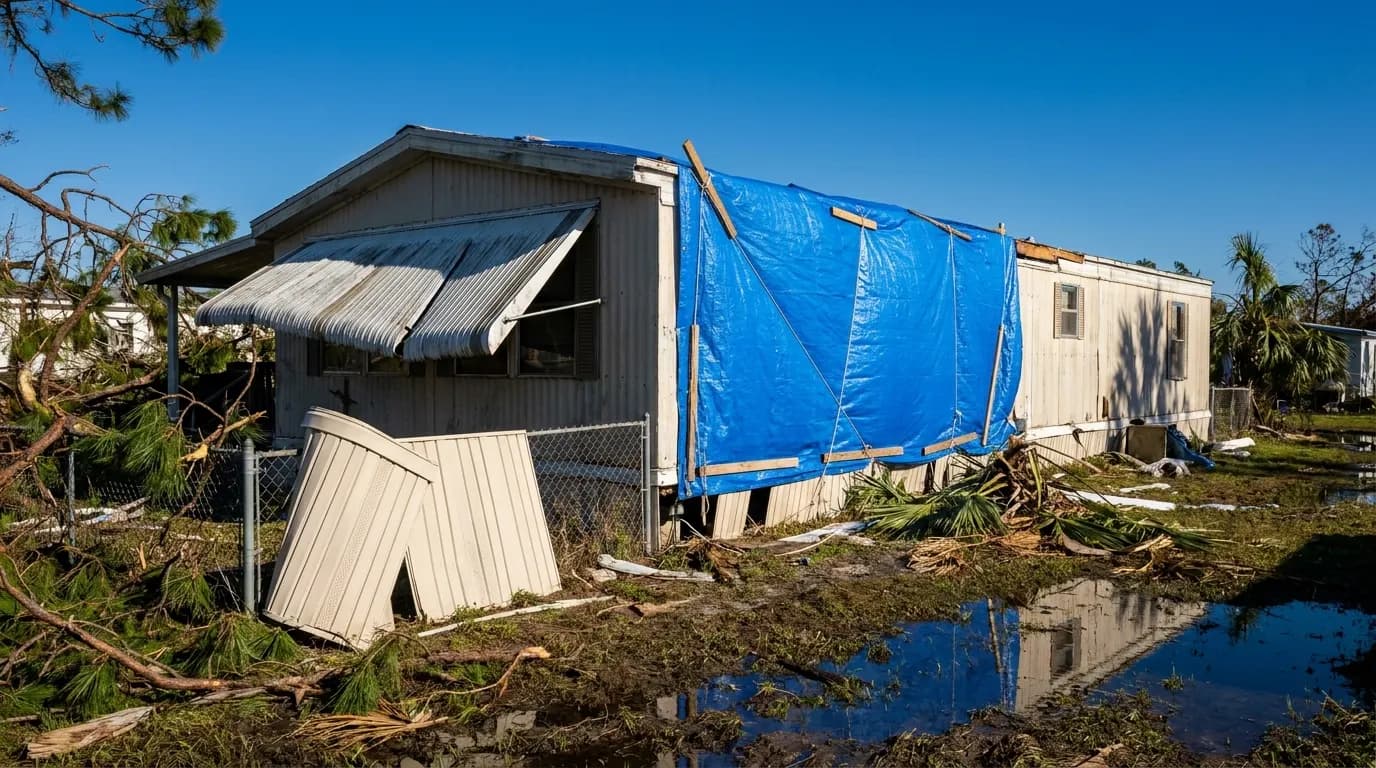
After a bad storm season the same call comes in for months. A home took damage, the adjuster has been out, and the owner is trying to work out whether they have an asset, a liability or a pile of scrap on their land.
There is no single answer, but there is a reliable order to work it out in. The thing that decides the most is usually not the damage. It is what happened to the title.
This article is general information about Florida titling procedure, insurance practice and floodplain rules. It is not legal, tax or insurance advice, and it is not a coverage opinion on your policy. Statutes, carrier practices and local ordinances change. Confirm anything that matters with FLHSMV, your carrier, your county building department and a Florida attorney.
Deal with the title before you deal with the damage
In Florida a mobile home carries a certificate of title, and a total loss settlement moves it.
Section 319.30 of the Florida Statutes handles this. When an insurer pays a total loss claim on a mobile home, it must obtain the certificate of title and forward it to the department for processing within 72 hours of receiving it, along with required National Motor Vehicle Title Information System notifications. Where the insurer cannot obtain the assigned title after meeting specific conditions, it can obtain a salvage certificate or a certificate of destruction from the department anyway.
The statute also sets a threshold that matters for uninsured homes. Where repair costs reach a defined high proportion of the home's current retail value, the department issues a certificate of destruction, which authorizes the home to be dismantled or destroyed rather than retitled. Check the current text of 319.30 for the exact percentages, because they are specific and they can change.
Why this is first and not last: a home with a certificate of destruction against it cannot be sold to somebody who wants to live in it. The paperwork has closed that door. If you are weighing a total loss settlement, you are also deciding whether the structure has a future.
Retaining salvage. Many carriers will let an insured keep the home and take the salvage value out of the settlement. That can be the right call where the damage is localized and the owner can do the work. It is often the wrong call where the damage is structural, because you now own a damaged home with a marked title and a disposal problem.
Get the carrier's position in writing, including what title outcome they intend to pursue, before agreeing to anything. The Florida form is HSMV 82363, the application for a salvage title or certificate of destruction.
What actually still has value
The land, most of the time. In Central Florida this is frequently the bulk of the remaining value. A cleared, improved site with a septic system, a well or a water tap, a power drop and a driveway is worth real money whether or not the home on it survived.
The site improvements. The septic, the well, the electrical service, the pad, the driveway and the permits behind them. Replacing those on raw land is expensive, and a buyer setting a different home there is buying exactly that.
Mechanicals and fixtures, if the home is going to be scrapped. HVAC equipment, water heater, appliances, undamaged windows and doors, and copper. It is not a large number and it is labor to extract, but a demolition contractor will value it in their bid whether or not they tell you.
The frame and running gear. On a demolition home the steel chassis has scrap value. On a home that might be moved, an intact frame with axles and a hitch is worth far more, because it means the home can be relocated at all.
The structure, if the damage is above the frame and outside the floor. Roof damage, skirting, siding, a blown out window, a torn off carport. These are repairable and they do not by themselves make a home worthless.
What genuinely destroys value
Water in the floor and walls. A manufactured home floor is typically particleboard or OSB over a vapor barrier. Once it takes standing water it does not recover, and the damage spreads outward from where it started. Soft floor is the single most common reason we price a home as a teardown.
Frame twist or separation. If the home moved on its piers, if the marriage line separated, or if the chassis is bent, everything downstream is compromised. Doors stop closing, the roof stops draining, and a hauler will not take it.
Mold that has had a Florida summer. Weeks with no power and a tarped roof does more damage than the storm did. This is why the timeline matters after a claim.
Roof deck separation. Not shingles or metal panels, which are replaceable, but the deck and truss connections. That is a structural repair on a manufactured home and it is rarely economic.
The floodplain rule that can decide everything
If the home is in a flood zone, there is a rule that surprises owners and it has nothing to do with your insurer.
Under the National Flood Insurance Program definitions at 44 CFR 59.1, "substantial damage" means damage of any origin sustained by a structure whereby the cost of restoring it to its before damaged condition would equal or exceed 50 percent of the market value of the structure before the damage occurred. "Substantial improvement" uses the same 50 percent test for reconstruction and rehabilitation.
The consequence: where a local floodplain administrator determines a structure was substantially damaged, the rebuild generally has to meet the floodplain management and code requirements that apply to new construction. For a manufactured home in a flood zone, that can mean elevation requirements and installation standards that were not in play when the home was originally set.
Two things to understand. The determination is made by local officials administering the county or city's own floodplain ordinance, not by FEMA and not by your carrier. And the 50 percent figure is a federal minimum, which a state or community may make stricter.
Call the county building department early, before you spend money on repairs.
The order we would work it in
- Document everything before anything is touched. Photographs of every room, every elevation, the roof, under the home, the piers and the anchors. Video walking through. Date stamps.
- Get the carrier's position in writing. Repair or total loss, what they intend to do with the title, and whether retaining salvage is available and at what deduction.
- Find out the title status. Live title, salvage certificate, certificate of destruction. This determines what the home can ever be again.
- Call the county building department about substantial damage and floodplain requirements before committing to a repair plan.
- Check the data plate. If the home might be relocated rather than repaired in place, the wind zone determines where it can legally go. See the wind zone article.
- Then decide. Repair, sell as-is, sell for removal, or demolish and keep the land.
Doing steps four and five after step six is how owners end up spending money on a home that could never be permitted back onto the site.
The uncomfortable honest part
Sometimes the right answer is that the structure is finished and the value is in the dirt.
Owners resist that, understandably. It was somebody's home. But a storm damaged older manufactured home can carry negative value once you count demolition and disposal, and the longer it sits open to the weather, the worse that gets. The land underneath is usually fine.
We would rather tell you that in the first conversation than let you spend a season finding out.
What we buy
We buy manufactured homes on private land across Central Florida, including storm damaged homes and homes that need to come off the land. Where a home can be repaired or relocated, that is worth something to us. Where it cannot, we can usually still talk about the land and the removal.
Send us photos and the details and we will give you a straight read on what is left, including when the answer is demolition. Our FAQ covers the questions we get most often, and you can read more about how we work.
Sources: Florida Statutes 319.30, Dismantling, destruction, change of identity of motor vehicle, vessel, or mobile home; salvage; FLHSMV form HSMV 82363, Application for Salvage Title or Certificate of Destruction; 44 CFR 59.1, Definitions; Florida Department of Financial Services, Division of Consumer Services